How AI Is Transforming Personal Finance Management


Artificial intelligence is changing personal finance management by turning large amounts of financial data into practical insights. AI-powered tools can categorize transactions, identify spending patterns, suggest savings actions, monitor cash flow, and help people compare financial products.
These tools can make everyday money management faster and more accessible. They also require judgment. An algorithm may miss a recent life change, misunderstand a transaction, or recommend an option that does not fit your priorities. The most useful approach treats AI as a financial assistant rather than an unquestioned authority.
What AI Means for Personal Finance
Artificial intelligence in personal finance analyzes financial data, recognizes patterns, and produces predictions or recommendations that support money-management decisions. It can process information continuously, which helps users monitor finances between monthly reviews.
When you connect an account to an AI-enabled service, the system may examine transaction descriptions, account balances, recurring payments, income patterns, and stated goals. It can then identify trends such as rising subscription costs, irregular cash flow, or spending that differs from your budget.
There is an important distinction between three functions:
- Automation completes a defined task, such as moving money after payday.
- Recommendation suggests an action, such as reducing a category or reviewing an insurance policy.
- Decision-making involves accepting financial risk, selecting investments, or changing coverage.
AI is strongest at the first two functions. The third still needs personal context, careful review, and, where appropriate, human financial advice. A budgeting model can see that grocery spending increased; it may not know that you are caring for a family member or following a medically required diet.
Smarter Budgeting and Expense Tracking
AI budgeting tools simplify expense tracking by automatically categorizing transactions, detecting spending patterns, and providing personalized budget suggestions. They can also monitor cash flow and alert you before a shortfall becomes a problem.
Traditional budgeting often depends on manually recording every purchase. AI can reduce that workload by reading transaction descriptions and assigning them to categories such as housing, transport, food, entertainment, or insurance. Users can correct mistakes, helping some systems improve future classifications.
AI can also create a more realistic picture of spending. Instead of showing only a monthly total, it may identify:
- Recurring charges that are easy to overlook
- Unusual transactions that need verification
- Seasonal increases in utility or insurance bills
- Cash-flow gaps between income and major payment dates
- Categories where actual spending regularly exceeds the planned amount
Personalized alerts are useful when they lead to a clear action. For example, a tool might warn that several annual subscriptions are due next month or show that a budget is being consumed unusually early. The limitation is accuracy: a refund, transfer, shared household purchase, or business expense may be classified incorrectly. Review transaction categories and account statements before acting on an automated insight.
Automated Saving and Financial Planning
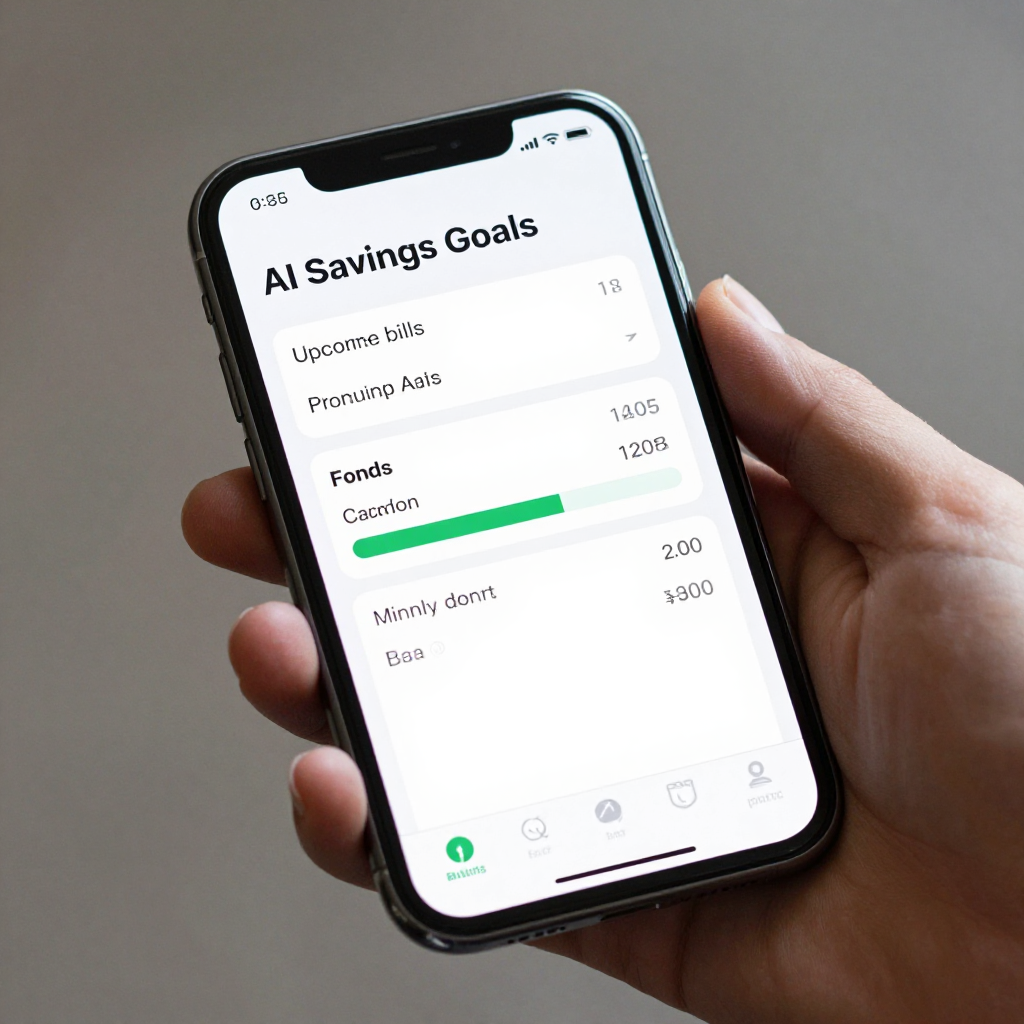
AI supports automated savings and financial planning by finding available cash, forecasting recurring expenses, and connecting day-to-day behavior with longer-term goals. It can help turn vague intentions into scheduled actions.
Some services analyze income timing, account balances, and spending history to estimate how much may be safe to transfer to savings. Others create goal-based plans for an emergency fund, a holiday, a home deposit, or an upcoming annual bill. Forecasting can be especially helpful for people with several payment dates or variable income.
A practical planning system should separate goals by time horizon:
- Immediate needs: bills, rent, premiums, and essential living costs.
- Near-term reserves: emergency savings and predictable annual expenses.
- Long-term objectives: retirement, education, or other goals that may involve investing.
AI can estimate whether a target appears achievable based on current contributions, but the result depends on the quality of its data and assumptions. It cannot guarantee income, interest rates, investment performance, or future expenses. Keep a cash buffer and review automated transfers after major changes such as a new job, debt, medical cost, or household responsibility.
AI in Investing and Insurance
AI is influencing investing through robo-advisors and risk profiling, while insurance technology, or insurtech, uses data to improve comparisons, underwriting, customer service, and claims support. In both areas, recommendations should be checked against coverage needs, risk tolerance, and personal circumstances.
Robo-advisors and investment support
Robo-advisors typically ask about goals, time horizon, income, and tolerance for market losses before proposing a portfolio. AI may help rebalance assets, estimate risk exposure, or explain how a change in contributions could affect a plan.
The convenience comes with trade-offs. A questionnaire may not capture debt obligations, tax circumstances, ethical preferences, or emotional responses to a market decline. Fees, account protections, investment choices, and the assumptions behind a recommendation also matter. Never interpret an AI-generated projection as a guaranteed return.
Insurance technology and policy support
Insurtech platforms can compare policy features, identify missing information, answer routine questions, and support faster claims communication. AI may help insurers assess risk using information supplied in an application or collected through approved data sources.
Faster service does not automatically mean better coverage. Compare exclusions, deductibles, limits, waiting periods, renewal terms, and claim requirements rather than choosing a policy solely because an algorithm ranks it highly. For complex life, health, property, or business insurance needs, a licensed adviser or insurer representative can explain consequences that a simplified tool may miss.
Benefits and Limitations of AI Financial Tools
The main benefits of AI financial tools are efficiency, personalization, accessibility, and continuous monitoring; their main limitations are imperfect data, hidden assumptions, bias, and the risk of overreliance. A balanced evaluation asks what the tool can observe and what it cannot know.
AI can make financial planning easier for people who find spreadsheets difficult or lack access to ongoing advice. Automated reminders may prevent missed payments, while pattern recognition can reveal small expenses that add up over time. A tool can also present complex information in plain language.
Common weaknesses deserve equal attention:
- Inaccurate inputs: missing accounts or incorrect categories produce unreliable outputs.
- Limited context: a model may not understand family obligations, irregular income, or personal values.
- Algorithmic bias: historical or incomplete data can affect recommendations and eligibility assessments.
- False confidence: a polished explanation can make uncertain conclusions seem authoritative.
A useful rule is the scope test: use AI freely for organization and low-risk reminders, cautiously for recommendations, and with human review for irreversible or high-value decisions. The more money, risk, or legal consequence involved, the more important independent verification becomes.
Privacy, Security, and Responsible Use
Responsible use of AI finance tools requires careful control of data permissions, strong account security, transparent explanations, and human review of important recommendations. Convenience should never require unrestricted access to every financial account.
Before connecting a bank, credit card, investment, or insurance account, check what information the service collects, why it collects it, how long it retains it, and whether it shares data with third parties. Prefer data minimization: provide only the access needed for the task. Read the provider’s privacy policy and permission settings, not just its marketing page.
Use unique passwords, multifactor authentication, device updates, and official applications. Treat unexpected messages requesting login details, verification codes, or payment information as potential phishing attempts. Reputable financial technology still cannot eliminate fraud or data-breach risk.
Transparency matters too. You should be able to understand whether an output is a fact, an estimate, or a recommendation. If a tool cannot explain a significant result, pause before relying on it. In the United States, consumer guidance from the Consumer Financial Protection Bureau can provide broader context on financial well-being and consumer protection.
Keep records of important decisions, compare AI outputs with statements and policy documents, and ask a qualified professional when the issue involves taxes, retirement, debt restructuring, estate planning, or substantial insurance coverage.
How to Start Using AI for Personal Finance
To start using AI for personal finance, choose a reputable tool, define one measurable goal, connect the minimum necessary data, test the outputs, and review important decisions with human judgment. A gradual approach is safer than automating everything at once.
- Choose the task first. Begin with expense tracking, bill reminders, or a savings goal rather than complex investing or insurance decisions.
- Check the provider. Review security features, privacy terms, support channels, fees, and whether the service clearly identifies its assumptions.
- Set a baseline. Compare the tool’s categories and balances with recent account statements. Correct errors before using its forecasts.
- Create boundaries. Set alerts and transfer limits. Do not allow automated actions that could overdraw an account or disrupt essential payments.
- Review monthly. Reconcile transactions, assess whether recommendations still fit your goals, and remove unused account permissions.
- Escalate complex decisions. Seek human financial advice when consequences are significant, the situation is unusual, or the recommendation is difficult to explain.
Start with a 30-day experiment. Track whether the tool saves time, improves awareness, or prevents missed tasks. If it produces frequent errors or encourages impulsive decisions, disconnect it and return to a simpler method.
Frequently Asked Questions
How is AI used in personal finance?
AI is used for budgeting, expense tracking, cash-flow forecasts, automated savings, investment guidance, fraud monitoring, customer service, and insurance support. Its role ranges from completing routine tasks to generating recommendations.
Can AI help me create and maintain a budget?
Yes. AI can categorize transactions, identify recurring costs, suggest spending limits, and alert you when spending changes. Review categories regularly because automated classification is not always correct.
Is it safe to share financial information with AI tools?
Safety depends on the provider, permissions, security controls, and your own account practices. Check data policies, use multifactor authentication, minimize access, and avoid sharing passwords or verification codes with a chatbot.
Can AI replace a financial adviser?
AI can handle organization and provide general education, but it cannot fully replace human financial advice in complex situations. A qualified professional can consider legal, tax, family, behavioral, and insurance factors together.
How is AI changing insurance?
AI is helping insurers and insurtech providers process applications, assess risk, answer questions, detect potential fraud, compare policies, and support claims. Consumers should still review exclusions, limits, deductibles, and eligibility decisions carefully.
AI can give personal finance management a useful operating system: it watches patterns, reduces manual work, and surfaces decisions at the right time. Its value depends on accurate information, reasonable privacy controls, and a willingness to challenge the output. Used as support rather than authority, AI can help people make more informed financial choices without surrendering control of them.